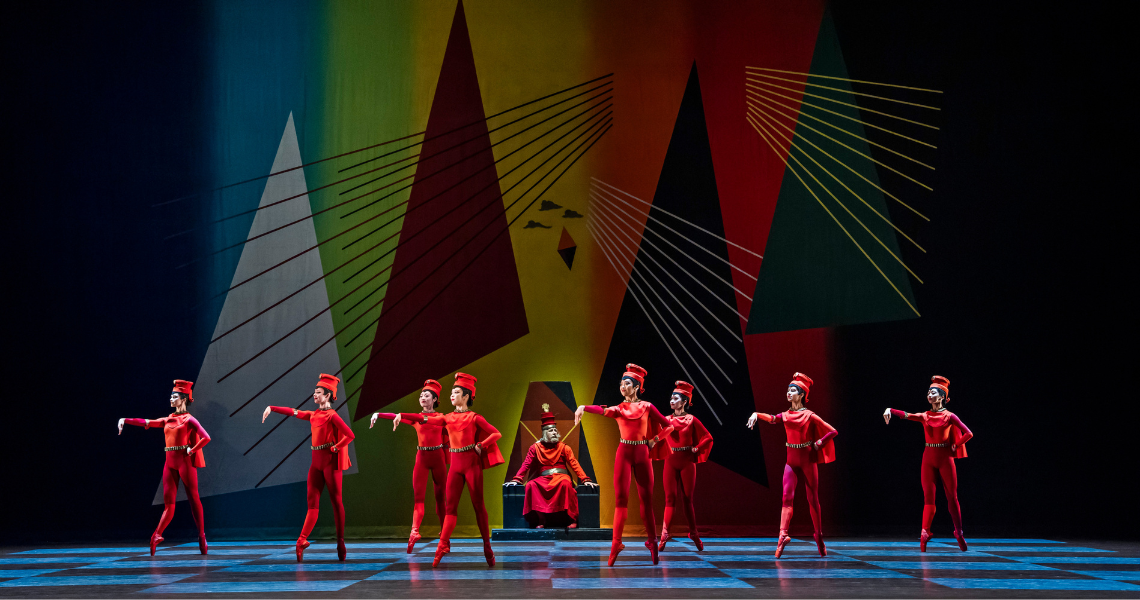
Dance critic Graham Watts visits Sadler’s Wells Theatre to review Ballet Boyz in Still Pointless, a powerful showcase of contemporary dance, athleticism and inventive choreography.

Michael Nunn and Billy Trevitt launched their company with Pointless, a skin-of-the-teeth show at the Roundhouse, and this celebration of the 25 years that have elapsed since then was largely a “Greatest Hits” retrospective of the work they have commissioned over this past quarter century.
The Ballet Boyz moniker is not something they chose, their company originally going by the name George Piper Dances referencing both their middle names, but the Ballet Boyz title was given to a Channel 4 documentary series that they made at the turn of the century, and it stuck.
Mention of the Ballet Boyz brings to mind several consistent qualities: a pervading quirky sense of humour, coupled with the self-effacement of not taking themselves too seriously; an obsession with film such that I imagine they even sleep with a camera glued to their chests; and an unfailing eye for talent, both in terms of commissioning new work and in selecting the male and male-presenting dancers (known as The Talent) that have
performed their work since Nunn and Trevitt’s retirement from the stage in 2010.
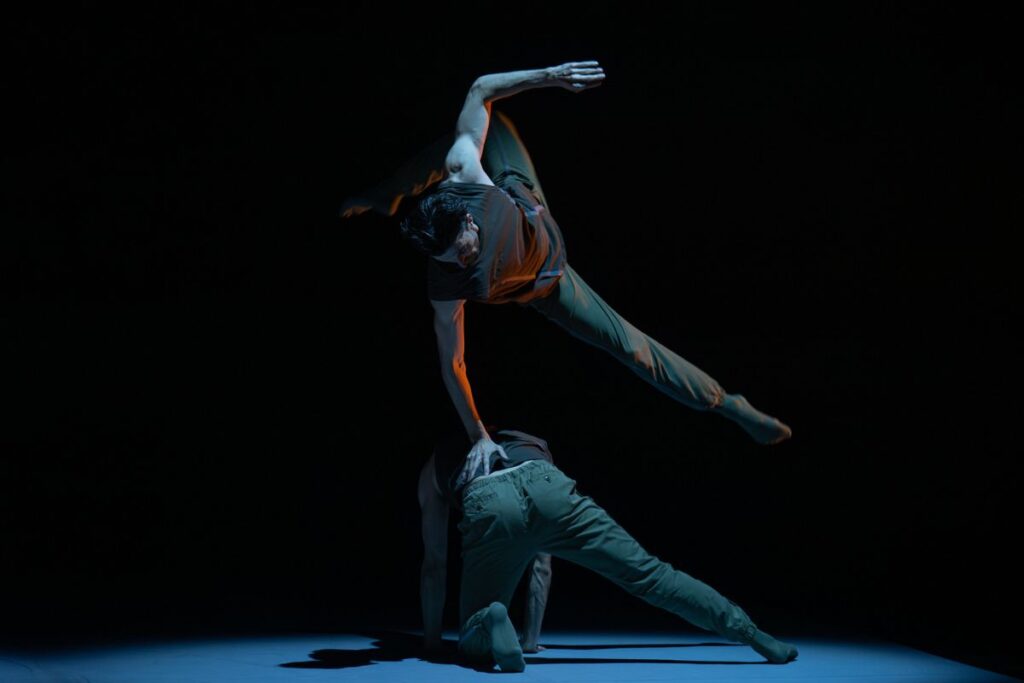
That there is no such thing as retirement was proven once more by the fact that the company’s founders began this celebration by once again performing Russell Maliphant’s Critical Mass, repeating the opening of that debut show, in 2001, having learned the complex torsion and balances from a videotape! Although there is almost no movement of the feet, the continual armography and mutually dependent upper body bends and spirals,
starkly exposed under Michael Hulls’ downward lighting, is fiendishly challenging and the pair, now both in their late 50s, accomplished this perpetual motion with steely concentration and impressive litheness.

True to form, the evening had begun with what seemed like a live recording of the two backstage complaining about being late, as if a tape had been left running accidentally, and such amusing snippets were a leit motif throughout the show. The obsession with film paid dividends with clips shown from throughout the company’s life including some hilarious backstage footage from that original Roundhouse show, revealing for example that only seven tickets had been sold just days before the opening! Each of the excerpts from later work were introduced by contemporary film, including poignant footage of the late Liam Scarlett describing his Serpent, which was made on the company in 2013.

Critical Mass, the oldest work, was immediately followed by the only new work, which was entrusted to Serian Griffiths, a current member of the company, and Motor Cortex was a dark and compelling world premiere, with geometric patterns interrupted by Andrew Ellis’ stop-start lighting. Griffiths is clearly yet another success in the Nunn/Trevitt conveyor belt of talent spotting.
The three further pre-interval excerpts were from Xie Xin’s Ripple, which does what it says on the tin with motion that takes on a fluid flow of energy; the early return of another piece by Maliphant, Fallen from 2013, one of two works from that period (alongside his Second Breath for English National Ballet) that dealt with the trauma of
war; and Iván Pérez’s memorable Young Men, preceded by evocative film of the work portraying the camaraderie of soldiers on a muddy battlefield.
The second half contained contemporaneous film of a plethora of choreographers discussing their work for The Talent and opened with Scarlett’s Serpent, choreographed fluidly to a luscious score by Max Richter. It was a reminder of how much artistry was lost with Scarlett’s tragic death at just 35.
I had fond memories of Bradley 4:18, a dark piece made around the time of the first Covid lockdown, choreographed by Maxine Doyle to a jazzy score by Cassie Kinoshi, telling the story of a successful young man increasingly struggling to connect with the world around him, a psychological deterioration physically manifested through changes in the suit that he wore.

Christopher Wheeldon’s Us brought the performance back to a duet, this time between Paris Fitzpatrick and Dylan Jones, softening the atmosphere into a more lyrical and sentimental journey, underpinned by Keaton Henson’s wistful music. The evening ended with Javier De Frutos’ Fiction (created in 2016), which builds on the
premise that the choreographer had just been killed by a falling piece of scenery prior to the premiere of his latest work. Ismene Brown’s obituary is read in a recording by Jim Carter and Ismelda Staunton while the dancers prepare for the show backstage, the obit words morphing into Ben Foskett’s score with the disco beat of Donna Summer’s Last Dance serving as a tongue-in-cheek reference to the choreographer’s death and that the
show must go on! This classic work was a great piece with which to end this fond trip down memory lane!

Ballet Boyz will be touring the UK. Dates and tickets are available here.